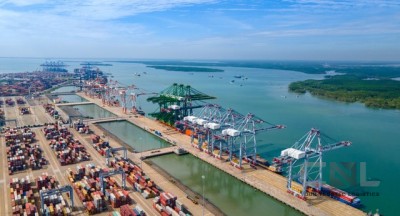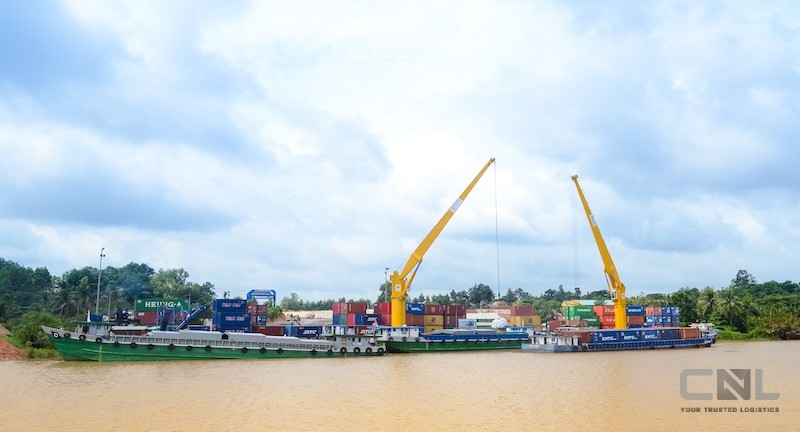

The whole country has invested, announced and put into operation 10 dry ports, including Nhon Trach Dry Port.
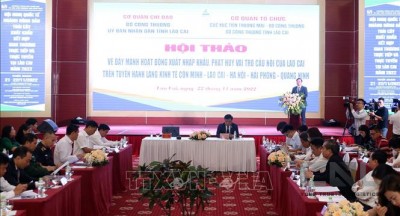
At the consultation workshop on "Planning for the development of the dry port system in the period of 2021-2030, with a vision to 2050", Deputy Minister of Transport Nguyen Xuan Sang said that after 20 years of development, Vietnam's seaport system is shaped with a total length of over 90 km, full loading and unloading capacity with customs clearance capacity of about 750 million tons / year.
As a type of development later than seaports, but currently dry ports are interested in investing in areas and transport corridors with large container cargo traffic such as Mong Cai - Quang Ninh, Dinh Vu - Hai Phong, Que Vo - Bac Ninh, Gia Lam - Hanoi, Duy Tien - Ha Nam, Nhon Trach - Dong Nai...
"Dry ports have made an important contribution to the organization of the transport network, taking advantage of the specific efficiency and transportation strengths of each region, especially inland waterway transport to transfer goods in large volumes, cheap prices and low pollution", Deputy Minister Nguyen Xuan Sang emphasized.
Mr. Pham Hoai Chung, Deputy Director of the Institute of Transport Strategy and Development reported the results of the study on the development plan of the dry port system in the period of 2021-2030, with a vision to 2050.
Accordingly, the dry port is a part of the transport infrastructure, the focal point for organizing container cargo transport associated with the operation of seaports, international airports, road border gates and international railways. Develop dry ports to organize container transport, increase the efficiency of logistics services on transport corridors, contribute to reducing traffic congestion at seaports, international border gates and large cities. Dry port development in Vietnam is becoming increasingly urgent.
In fact, the deployment of dry ports has been slow over the past time. Up to now, the whole country has invested, announced and put into operation 10 dry ports, in addition, 06 inland customs clearance ports – ICD are operating in the positions planned for dry ports, but the 3 investors have not carried out procedures for conversion into dry ports as prescribed.
The total volume of import and export goods by container through dry ports and inland customs clearance points (ICD) in operation is currently about 4.2 million TEU/year (Dry ports, ICD ports in the North through about 0.45 million TEU/year, the South about 3.65 million TEU/year), of which 90% of goods go through inland customs clearance ports (ICD), including 6 ICD ports planned to become dry ports and also Truong Tho ICD port cluster, Ho Chi Minh City.
The volume of cargo through the announced 10 dry ports only accounts for about 10% because most of them are newly formed and are located in the North, except for Nhon Trach New Port dry port in Dong Nai. With 35-40% of import and export goods by container going through customs clearance at the dry port. ports in the South promote the advantages of inland waterway transport (accounting for 35-40%), well support seaports in transshipment of import and export goods by container, reduce congestion at seaports and urban traffic in Ho Chi Minh City.
Notably, proposing solutions on investment for the development of the dry port system, Mr. Chung proposed to consider applying investment in dry port development in the form of public-private partnership (PPP) with large-scale dry ports in the direction of the State facilitating land fund, invest in connecting railways with dry ports, complete the legal environment and promulgate mechanisms and policies for the development of dry ports and private investment in infrastructure, equipment and organization of management and exploitation of dry ports.
At the same time, expanding and diversifying forms of investment in the direction of promoting socialization, encouraging and creating favorable conditions for enterprises to invest in the construction and exploitation of dry ports in the forms prescribed by law...
Meanwhile, a representative of the Ministry of Planning and Investment said: "With the detailed planning of the dry port group, it is necessary to propose specific policies in the solution. It must be clearly stated that the current regulations have problems that need to be removed for development."
According to the draft "Planning for the development of the dry port system in the period of 2021 - 2030, with a vision to 2050", the goal is to develop a dry port system capable of approving about 20% - 30% of the demand for import and export container transport goods with a total capacity of about 6-8.7 million Teu/year. In particular, the North includes dry ports, dry port clusters with a capacity of about 2.2 - 3.0 million Teu/year; the Central - Central Highlands has dry ports and dry port clusters with a capacity of about 0.24 - 0.37 million Teu / year; The South has dry ports, dry port clusters with a capacity of about 3.5 - 5.3 million Teu / year.
By 2030, developing a dry port system is likely to pass about 25% - 35% of the demand for import and export container transport goods under transport corridors. Forming dry ports, dry port clusters with a total capacity of about 11.6 - 15.7 million Teu /year. In particular, the North includes dry ports, dry port clusters with a capacity of about 4.2 - 5.5 million Teu/year; the Central - Central Highlands has dry ports, dry port clusters with a capacity of about 0.66 - 0.95 million Teu / year; The South has dry ports and shallow port clusters with a capacity of about 6.8 - 9.3 million Teu per year.
Oriented to 2050, develop the dry port system to become the focal point for transport, transshipment and distribution of goods, combined with the provision of logistics services, capable of passing about 30% - 35% of the demand for import and export container transport goods under transport corridors, at the same time meet the needs of logistics services in localities.
According to Thy Hang/diendandoanhnghiep.vn