China Southern Airlines, the largest cargo airline in China and 10th largest in the world by volume, has begun allowing freight forwarders to book shipments and make payments on WebCargo, a Freightos marketplace connecting air and ocean carriers with logistics companies that arrange freight transportation.
The partnership with China Southern Airlines’ air logistics arm marks Freightos’ entry into the large China market, which represents 11% of global air cargo trade, according to figures from the International Air Transport Association. China Southern Air Logistics is the first airline in China to participate in a digital freight marketplace.
Freightos announced its expansion with China Southern, which initially is limited to imports into China, on Tuesday.
Multiparty booking platforms for air and ocean shipments are rapidly gaining traction, simplifying the customer experience and saving huge amounts of time by replacing manual checks with real-time electronic connections.

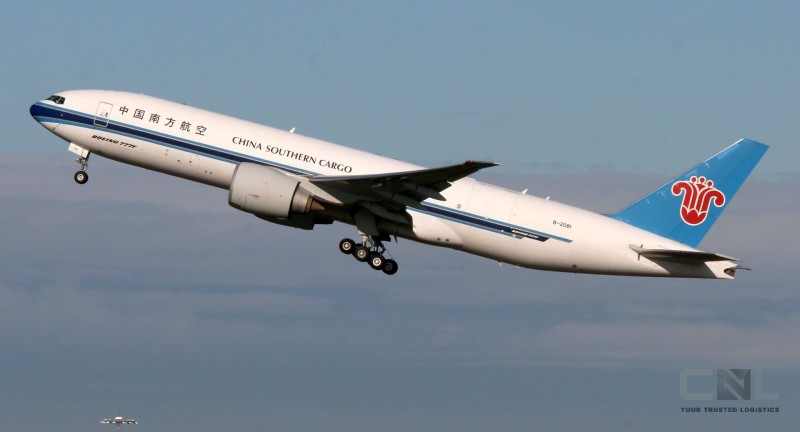
A China Southern Cargo 777 freighter takes off from Stansted airport in the U.K. in October 2020. (Photo: Flickr/Steve Knight CC BY 2.0)
Freightos, which this year announced plans for a public stock offering in 2023 to fund growth as it tries to turn a profit, is one of the primary technology companies enabling buyers to shop for freight transportation and see real-time rates from multiple suppliers in one display. Businesses book freight with intermediaries on the Freightos website, while forwarders use WebCargo to connect with carriers’ reservation systems. Last summer, Freightos established its first foothold in Latin America when Latam Cargo, the largest cargo carrier in the region, joined WebCargo.Forwarders use WebCargo for instant rate quotes and real-time price comparisons before booking, and to make digital payments.The advantage of automatically connecting the forwarders’ transportation management systems with airline reservation systems is more predictable, transparent pricing and capacity information that can be confirmed instantly, as passengers are used to when booking tickets. Until recently, much of the online pricing was still static, with rates typically coming off an Excel spreadsheet and requiring a human to manually confirm the price and booking in the system. In many cases, phone calls and emails are also required to finalize a booking.
“The return on investment is clear. I mean, number one, it’s giving a better service to the customer. Especially with younger people coming into the industry, they expect instant service, and the average time for a forwarder who doesn’t have the right tools to do a simple price quote is three days,” Freightos CEO and founder Zvi Schreiber said in an interview last summer. “Second of all, the accuracy of the quote. Because rates are changing so quickly, if you don’t have the right tools, you quote the wrong price. If it’s too low, you lose money. If it’s too high, you don’t get the business.
“And then third of all, it’s the internal cost, you know, there’s a shortage of staff in the industry. So I think it’s clearly becoming a competitive necessity, both from a customer perspective and from a cost perspective, to have automation tools.”
Experts also say the move to digital booking was prompted by capacity shortages during the pandemic and the need to reserve space quickly or risk losing it to a competitor.
More than 3,500 freight forwarders using the Freightos system now have access to China Southern’s capacity.More than 30 airlines, representing more than 50% of global airfreight capacity, list their capacity on WebCargo, giving them another sales channel beyond their branded websites. Most of the airlines have joined the platform in the past two years.
“Digital transformation has become key to staying ahead. We are happy to embrace e-solutions to optimize our sales, and believe our cooperation with WebCargo will bring considerable added value to our customers. Aiming to become a competitive global integrated logistics provider, China Southern Air Logistics will devote great efforts to enhance our digital capabilities,” said Executive Vice President Chengqing Tao in a news release.
China Southern Airlines is a large passenger airline and also operates a fleet of 14 Boeing 777 freighters that fly 60 times per week from Guangzhou, Shanghai, Shenzhen and Chongqing to Amsterdam, London, Chicago and Frankfurt, Germany. In 2019 it spun off its cargo division into a separate company, China Southern Air Logistics. which also manages the belly cargo carried by its sister company. Officials say they plan to expand the freighter fleet and launch more international routes.
freightwaves.com-Eric Kulisch