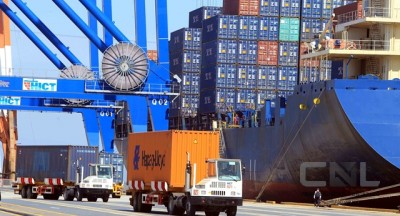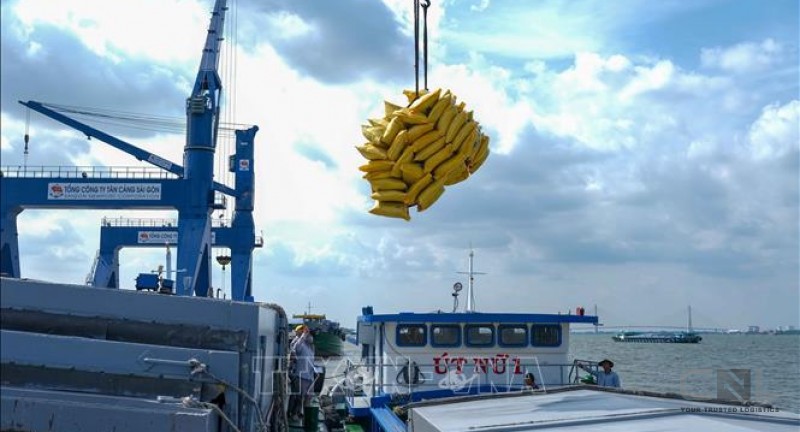

Bốc dỡ hàng hóa tại cảng Tân Cảng Cái Cui, thành phố Cần Thơ. Ảnh minh họa: Thanh Liêm/TTXVN
Inefficient connection
The Mekong Delta is the main rice bowl, accounting for over 54% of rice production, more than 95% of Vietnam's rice exports in the past decade. The region also contributes about 70% of fruit production, about 60% of the country's seafood exports. However, from the perspective of developing the logistics service system, the infrastructure and transportation conditions of the region are still limited, the warehousing system and transportation system have not met the needs.
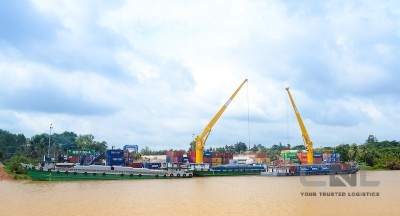
Associate Professor Tu Van Binh (Ho Chi Minh City University of Economics) and Associate Professor Nguyen Phu Son (Can Tho University) said that the transport system with the combination of water and ministry in the delta area has not been effectively exploited. This is partly because the infrastructure in the tributaries is not adequate for large-scale shipping. The whole region currently has nearly 2,170 river ports and loading and unloading berths, but the capacity is only low, small-scale, and there are no dedicated container ports.
In addition, the Mekong Delta has 12 seaports, 35 harbors, 4.9 km of wharves and seaports acting as a cargo collection satellite for major ports in Ho Chi Minh City and Cai Mep - Thi Vai (Ba Ria Vung Tau). However, in many places, the ship flow operates on a small scale, causing the delta to gradually lose its advantages in terms of transportation, including river and sea transport.
Meanwhile, road transport has to "shoulder" the large volume of transport for hours from the Mekong Delta to Ho Chi Minh City and the whole country, leading to the overload of logistics services, high logistics costs, reducing the efficiency of resource development of the region. The bottleneck of logistics services in the Mekong Delta today is the inefficient connection between road and water transport, roads and seaports, roads and airports.
Viewed from the system of variable ports and river ports, the Mekong Delta has 6 vertical and 9 horizontal axes with an overall length of more than 14,820 km, 57 inland waterway ports, nearly 3,990 inland waterways. Every year, there are about 17-18 million tons of agricultural products such as rice, fisheries and fruits that need to be transported by river and sea for export. But due to the smallness of many ports, the loading and unloading capacity is only 10,000 tons / year. Meanwhile, the cargo collection terminal for major inland waterway ports in the region is not guaranteed, so goods transported from the delta to foreign countries must pass through ports in Ho Chi Minh City and Cai Mep port.
A representative of Minh Phu Seafood Group Joint Stock Company said that the annual logistics cost of this enterprise to transport shrimp from two factories in Hau Giang and Ca Mau to Ho Chi Minh City to export to other countries is very large, about 60 billion VND. If there is a more reasonable logistics service, goods can be exported directly from the Mekong Delta, not to Ho Chi Minh City, businesses will save costs by about 30-40%, the competitiveness of agricultural products will also be higher.
Sustainable development solutions
Developing a logistics service system for the Mekong Delta is a very urgent issue, requiring many synchronous solutions, not just a few single solutions, lacking fundamentality.
According to Mr. Nguyen Phuong Lam, Director of the Vietnam Federation of Trade and Industry Can Tho Branch, the Prime Minister approved the planning of the Mekong Delta region in the period of 2021-2030, with a vision to 2050. This is an important planning, bringing strategic adjustments to bring the Mekong Delta to rapid and sustainable development.
Along with that, many large projects are being built and planned for transport investment for the Mekong Delta, which is considered a turning point for change. If local governments accelerate the progress of logistics center projects, there are priority investment policies, it can be said that the next 5 years will be a golden period for the logistics industry. This is also considered the most attractive investment industry in the Mekong Delta today.
In order to develop the logistics service system, two Associate Professors Tu Van Binh and Nguyen Phu Son said that completing the inland waterway transport system is one of the important solutions. Sectors and localities need to focus on solving bottlenecks, connecting inland waterway ports with roads, highways, industrial parks, seaports ... create more favorable conditions for the goods of enterprises in access to the method of water transport.
At the same time, sectors and localities should continue to invest in infrastructure systems that adapt to the requirements of the main trade corridor of free trade agreements, mobilize the participation of the private sector in capital financing and service provision; strengthen domestic capital for investment projects to develop inland waterway transport networks, improve the coordination capacity of inland and sea transport.
For the road transport system, quick completion of the planned southern key highways. In addition, all levels and sectors develop seaport and river port systems, creating conditions for ships to transport efficiently in terms of time and load. As for developing a cargo transportation system by air, it is necessary to calculate the transportation of fresh goods such as vegetables, fruits and seafood to reach consumers in the fastest way and ensure quality.
In addition, the establishment of a regional logistics center is very necessary, because it will help the logistics system of localities in the region solve the problem of high logistics costs compared to neighboring countries such as Thailand, Indonesia, Singapore ... The logistics center helps connect with international shipping lines to flexibly regulate containers, avoid imbalances and push container rental prices too high and contribute to limiting loading and unloading through many intermediaries.
From an enterprise perspective, referring to the strategy of developing regional logistics centers for agricultural products, Director of Hanh Nguyen Food Co., Ltd. Pham Tien Hoai said, in order for delta agricultural products to compete compared to other countries in the region and reach the world, The establishment of logistics centers specializing in agricultural products is a mandatory requirement, contributing to reducing logistics costs from 30% to about 15% of product costs.
"At these centers, there will be all services to serve and support agricultural products from purchasing, to sorting, selecting, washing, packaging, sterilization irradiation, cold storage to export customs clearance. In order to develop more logistics centers for agricultural products in the Mekong Delta, special support policies from local authorities and the Government are needed for farmers, producers, importers and investors. Thus, it is possible to improve the competitiveness of goods from localities in the Mekong Delta", Mr. Pham Tien Hoai affirmed.
Thanh Tra (VNA)-baotintuc.vn